The Fantastic Four. Just hearing those words likely conjures images of super-powered heroes, cosmic adventures, and perhaps, most distinctly, a bold, iconic number "4." But beyond the thrilling tales, lies a fascinating study in brand longevity and commercial might. The Commercial Use and Merchandising Power of the Fantastic Four Logo isn't just about selling toys; it's about a symbol that has transcended its comic book origins to become a globally recognized emblem, driving billions in revenue and anchoring a vast multimedia empire.
This isn't merely a static emblem; it's a dynamic asset that has adapted, evolved, and consistently reaffirmed its place in the pantheon of superhero iconography. For over six decades, this logo, primarily featuring the prominent numeral "4," has been the visual shorthand for Marvel’s First Family, a testament to enduring design and strategic brand management.
At a Glance: Decoding the FF Logo's Market Influence
- Iconic Simplicity: The "4" symbol is instantly recognizable, transcending language barriers.
- Decades of Evolution: The logo has adapted across comics, animation, and film, maintaining core elements.
- Merchandising Goldmine: A strong visual identity fuels sales across toys, apparel, collectibles, and more.
- Nostalgia & New Audiences: The logo appeals to long-time fans while captivating new generations.
- Brand Consistency is Key: Despite variations, the core "4" glyph ensures continuous brand recognition.
- Strategic Licensing: Careful management of the logo's use is crucial for maintaining its value and avoiding dilution.
From Cosmic Rays to Commercial Clout: The Fantastic Four's Genesis Story
Imagine a world captivated by the space race, a desire to explore the unknown. It was this burgeoning obsession that sparked an idea in the minds of writer Stan Lee and artist Jack Kirby, leading to the debut of "The Fantastic Four #1" in 1961. This wasn't just another superhero team; it was a family. Reed Richards, the brilliant Mr. Fantastic; Sue Storm, the resourceful Invisible Woman; Johnny Storm, the hot-headed Human Torch; and Ben Grimm, the ever-lovin' blue-eyed Thing. Their powers, bestowed by cosmic radiation during a ill-fated space adventure, set them apart, but their relatable, often dysfunctional, family dynamic cemented their place in readers' hearts.
From battling cosmic entities like Galactus to clashing with their arch-nemesis Doctor Doom, the Fantastic Four's adventures quickly resonated, laying the groundwork for what would become the Marvel Universe. This foundational success wasn't confined to comic book panels alone; it quickly branched out into television shows, movies, books, and video games, each new iteration further solidifying the team's presence in popular culture. This pervasive presence is the bedrock upon which the commercial power of their logo is built – consistent exposure creates ubiquitous recognition.
The Evolving Icon: A Visual History of the Fantastic Four "4"
A logo, at its core, is a promise—a distillation of a brand's essence. For the Fantastic Four, that essence has been consistently embodied by the number "4," typically encased in a circle, often in striking blue and white hues. This symbol isn't just a design; it's a beacon that has guided fans through decades of adventures, adapting subtly to the times while retaining its core identity.
The Birth of a Symbol: Early Comic Book Designs (1961-1970s)
When the Fantastic Four first burst onto the scene in 1961, their logo was as raw and energetic as their debut. The initial wordmark was characterized by an uneven, bouncy font, sometimes prefaced with "the," reflecting the dynamic, almost hand-drawn feel of early comic art. It was bold, albeit a little rough around the edges, perfectly capturing the experimental spirit of the era.
By 1972, as the team matured and found its stride, the logo evolved. A more straightforward font emerged, with "fantastic" gently curved at the bottom and "four" arched gracefully at the top. This design brought a new level of sophistication and readability, signaling a more established presence in the comic book landscape. These early iterations laid the groundwork for the simple yet powerful "4" motif that would become synonymous with the team.
Modernizing Marvel's First Family: Comic Logos Through the Eras (1990s-Present)
The late 20th century saw another stylistic shift. In 1998, the logo paid homage to its origins, reintroducing a font similar to the original but with added shadowing, creating a hovering 3D effect. This touch added depth and modernity, a nod to the growing sophistication of comic art and printing. Some versions even integrated character names subtly over the central "4" symbol, emphasizing the individual heroes within the collective.
The 2010s brought a more radical departure. The 2014 comic book logo introduced a modernized wordmark where letters connected, featuring a bold top line. In a rather experimental move, the letter "A" in "Fantastic" was replaced with a "4" glyph. While innovative, this design was sometimes criticized for being less legible, proving that sometimes, familiarity trumps pure novelty in brand recognition.
However, the most recent comic book logo from 2018 demonstrates a return to clarity and classic appeal. It adopted an old-fashioned yet clearer 3D serif font, designed to give the impression of looking up at a grand, heroic sign. Crucially, this design strategically incorporates the familiar "4 glyph surrounded by a circle" right next to the word "Four," ensuring immediate identification. This blending of classic aesthetics with modern execution highlights an understanding of legacy and brand strength.
Silver Screen and Small Screen: Translating "The Four" to Animation and Film
The Fantastic Four's journey to other media brought new interpretations of their iconic emblem, each adaptation catering to its specific audience and aesthetic trends.
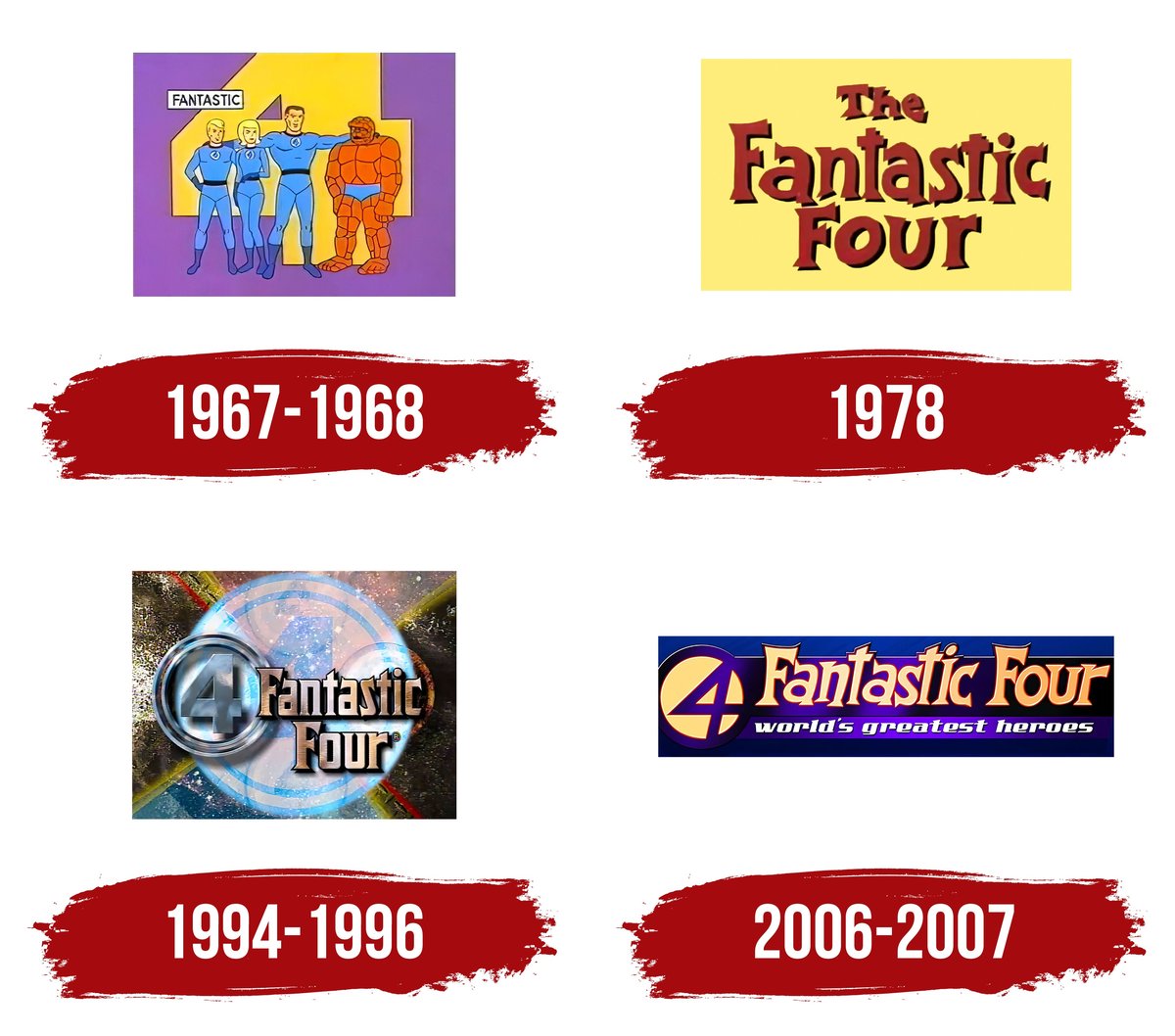
Early animation often used a simple yet effective visual: the four characters standing prominently in front of a large yellow "4." The 1967 animated series refined this, featuring a large yellow "4" in the background, with "Fantastic" rendered in a stark white rectangle. The 1978 animated series, perhaps leaning into nostalgia, based its logo on the original comic book design, using a bright red font to grab attention.
The 1990s brought more sophisticated animation and with it, a more intricate logo. The 1994 animated series introduced metallic-looking glyphs and innovatively used the "4" symbol in two ways: once to the left of the wordmark and again as a transparent, ethereal presence behind it, adding depth to the title sequence. The 2006 animated series returned to a font reminiscent of the original comic books, consistently placing the Fantastic Four symbol on the left, reinforcing its status as a core identifier.
When the team finally hit the big screen, the logos went full Hollywood. The 2005 film featured a modern, metallic-edged title screen where the Fantastic Four symbol dramatically separated the words "Fantastic" and "Four." A decade later, the 2015 film remake opted for a slimmer, modern, powerful, and futuristic font. Mirroring some comic designs, this version also replaced the letter "A" with the "4 glyph," signaling a bold, new era for the team, even if its reception was mixed.
The MCU's Embrace: Future Legacy and Recognizability
The Fantastic Four's emblem continues its influential journey, now with significant appearances within the Marvel Cinematic Universe (MCU). The logo from the 2000s live-action duology (directed by Tim Story) notably re-emerged in the 2024 MCU film Deadpool & Wolverine, a clever nod to continuity and fan service, with Chris Evans even reprising his role as Johnny Storm/Human Torch from that era. Similarly, the logo appeared in the 2022 MCU film Doctor Strange in the Multiverse of Madness, featuring John Krasinski as Reed Richards/Mr. Fantastic. These appearances, alongside the implication of a future film in 2025, underscore the logo's inherent power to instantly communicate "Fantastic Four" to a global audience, regardless of the specific iteration of the team.
Why Consistency Reigns: Colors, Glyphs, and Lasting Impressions
What’s truly remarkable is the consistent branding across these varied interpretations. The core elements—the number "4," often within a circle, and the consistent use of blue and white as primary colors—have remained steadfast. While the most recent comic book logo embraces a classic serif font with capital letters and sharp components, the most recent movie logos lean towards simpler sans-serif fonts with sleek, narrow lines, catering to contemporary cinematic aesthetics. Yet, both retain that unmistakable "4." This strategic consistency demonstrates how a superhero team can establish and maintain a strong visual identity over time, ensuring that no matter the medium or specific design trend, the essence of the Fantastic Four remains instantly recognizable. To truly appreciate this journey of visual identity, you might want to Explore the Fantastic Four logo in greater detail, witnessing firsthand how subtle changes contribute to monumental brand strength.
Beyond the Pages: The Commercial Use and Merchandising Power of the Fantastic Four Logo
The Fantastic Four logo isn't just a pretty picture; it's a potent commercial asset. Its evolution and pervasive presence across various media have cultivated a brand identity so strong that the "4" alone can trigger recognition, nostalgia, and purchasing intent. This is the ultimate goal of any successful logo: to become an unspoken promise of what a brand represents.
The "4" as a Merchandising Magnet
The power of the Fantastic Four logo in merchandising stems from its simplicity and immediate association. Unlike complex illustrations, the bold numeral "4" is clean, scalable, and instantly identifiable, even at a glance. It's a design that lends itself perfectly to a vast array of products, from intricate collectibles to mass-market apparel. It signals quality, heroism, and a connection to a beloved universe without needing extensive text or character images. This universal appeal makes it a versatile tool for licensees.
Product Categories: From Action Figures to Apparel
The reach of the Fantastic Four logo in merchandising is truly "fantastic." Think about the sheer variety:
- Apparel: T-shirts, hoodies, hats, and even superhero cosplay costumes frequently feature the "4," often in its classic circular form.
- Toys and Collectibles: Action figures, statues, Funkos, and miniature vehicles often prominently display the logo, adding to their authenticity and appeal.
- Home Goods: Mugs, posters, blankets, and even kitchenware can be found emblazoned with the "4," bringing a piece of the Marvel universe into everyday life.
- Video Games and Software: The logo serves as a key identifier for games featuring the team, both on their covers and within the game itself.
- Books and Comics (beyond their own series): The logo often appears on ancillary materials, ensuring brand consistency across print media.
- School Supplies: Backpacks, notebooks, and pencil cases carrying the "4" appeal to younger fans eager to showcase their fandom.
Each product category leverages the logo's recognizability to attract consumers, tapping into their affinity for the characters and the broader Marvel brand.
Tapping into Nostalgia and New Generations
One of the logo's greatest strengths is its dual appeal. For long-time fans who grew up with the 1960s comics or the 1990s animated series, the classic "4" evokes a powerful sense of nostalgia. It reminds them of cherished childhood memories, prompting purchases driven by sentimentality.
Simultaneously, the continuous presence of the Fantastic Four in new comics, films, and video games ensures that fresh generations are constantly introduced to the brand. The updated, sleek movie logos, for instance, resonate with younger audiences familiar with modern cinematic aesthetics. This balance between honoring heritage and embracing contemporary design allows the logo to continuously recruit new fans while retaining its loyal base, ensuring a perpetual market for merchandise.
Leveraging Brand Identity in Pop Culture
The Fantastic Four logo transcends mere product sales; it's a pop culture icon in its own right. Its appearance in other MCU films, even for a brief moment, generates significant buzz and excitement. It acts as a powerful shorthand, instantly communicating the arrival or presence of the team without needing lengthy explanations. This kind of symbolic power is invaluable, turning the logo into a cultural touchstone that signifies a beloved mythology and a long-standing legacy. It’s not just a logo; it’s a narrative cue.
Strategic Licensing: Maximizing Value and Protecting the Brand
The commercial success of the Fantastic Four logo is not accidental; it’s the result of careful, strategic licensing and brand management. Every product, every appearance, is a calculated move to both expand reach and protect the integrity of the brand.
The Business of Branding: Understanding Licensing Agreements
At the heart of the logo's commercial use are licensing agreements. These legal contracts grant third-party manufacturers the right to use the Fantastic Four logo (and associated imagery) on their products for a specified period and often within defined territories and product categories. For Marvel (and its parent company, Disney), this is a significant revenue stream, allowing them to monetize their intellectual property far beyond direct sales of comics or films. For licensees, it offers the immediate benefit of aligning with a globally recognized and beloved brand, boosting product appeal and sales. These agreements are meticulously crafted to ensure that the logo is used appropriately and in a manner consistent with the brand's values.
Preserving the Legacy: Quality Control and Brand Standards
A strong brand can quickly be diluted by inconsistent or low-quality merchandise. Therefore, rigorous quality control is paramount. Marvel and its partners maintain strict brand guidelines that dictate everything from color palettes and font usage to the precise placement and scale of the "4" symbol. This ensures that whether you pick up a high-end collectible or a simple t-shirt, the Fantastic Four logo maintains its premium feel and consistent aesthetic. This commitment to quality across all licensed products reinforces consumer trust and strengthens the brand's reputation. It’s not enough for the logo to appear; it must appear well.
Pitfalls to Avoid: Dilution, Counterfeiting, and Misrepresentation
Even the strongest brands face challenges.
- Brand Dilution: Over-licensing or allowing the logo to appear on too many disparate or low-quality products can dilute its impact, making it less special and diminishing its perceived value.
- Counterfeiting: The popularity of the Fantastic Four logo makes it a prime target for counterfeiters. Unauthorized products not only steal revenue but can also damage the brand's reputation if they are of inferior quality or unsafe. Robust legal enforcement and proactive monitoring are crucial.
- Misrepresentation: Ensuring the logo is never used in contexts that contradict the Fantastic Four's heroic and family-oriented values is also vital. This protects the brand's image and its connection with its audience. Strategic licensing is about saying "no" as much as it is about saying "yes."
Your Questions Answered: Decoding the Fantastic Four Logo's Market Impact
You might be wondering how such a simple symbol can carry so much commercial weight. Here are answers to some common questions:
How does the Fantastic Four logo appeal to new audiences?
New audiences are primarily introduced through fresh media like films, animated series, and modern comics. These productions often feature modernized interpretations of the logo, which resonate with contemporary design sensibilities. However, the core "4" glyph remains, offering a recognizable anchor that links them to the team's storied history. The logo acts as an entry point, drawing them into a universe they might then explore further through older comics or merchandise.
What makes the "4" symbol so effective for merchandising?
Its effectiveness lies in its simplicity, boldness, and immediate recognizability. It’s easy to reproduce on any material, from fabric to plastic, without losing clarity. The distinct shape and number create an iconic silhouette that doesn't require extensive knowledge of the characters to appreciate, making it accessible to a broader consumer base. It’s a clean, graphic identifier that stands out.
Are different logo versions licensed for different products?
Yes, absolutely. Licensing agreements are often highly specific. A licensee producing vintage-style apparel might be granted rights to use an older, comic-accurate logo, while a toy manufacturer developing products tied to an upcoming film might use the latest cinematic rendition. This segmented approach allows Marvel to maximize its licensing opportunities while ensuring brand consistency within specific product lines and target demographics. The versatility of the logo's history allows for tailored commercial applications.
The Ever-Expanding Universe of "The Fantastic Four" Brand
The journey of the Fantastic Four logo is a compelling narrative of adaptation, enduring design, and unwavering commercial power. From its bouncy, uneven beginnings in 1961 to its sleek, futuristic appearances in modern cinema, the "4" has consistently served as the unbreakable core of the team's visual identity. It's a symbol that has navigated decades of stylistic changes, technological advancements, and shifting audience preferences, emerging stronger and more recognizable with each evolution.
As the Marvel Cinematic Universe continues to expand, and with a future film implied for 2025, the commercial use and merchandising potential of the Fantastic Four logo are poised for even greater heights. It’s not just a mark; it's a powerful identifier, a nostalgic trigger, and a testament to the enduring appeal of Marvel’s First Family. For consumers, it’s a badge of honor, a connection to a beloved world of heroes. For businesses, it's a proven asset, a visual guarantee of quality and recognition that continues to drive sales and cement the Fantastic Four's place as a cornerstone of popular culture. The "4" isn't just a number; it's an empire.