The Fantastic Four. For over six decades, this cosmic family of adventurers has captured imaginations, pushing the boundaries of what a superhero team can be. But beyond their incredible powers and tumultuous family dynamics, there's a subtle yet powerful element that has traced their journey through every medium: their logo. Exploring Fantastic Four logo variations across film, TV, and games isn't just an exercise in design history; it’s a fascinating look at how a brand’s visual identity adapts, evolves, and maintains its core essence to resonate with new generations.
From the quirky, hand-drawn titles of their 1960s comic debut to the sleek, futuristic emblems adorning modern cinematic universes, each logo tells a story. It reflects the artistic sensibilities of its era, the narrative tone of the adaptation, and the enduring spirit of Marvel’s First Family.
At a Glance: The Fantastic Four's Evolving Emblem
- A Journey Through Time: The Fantastic Four logo has seen numerous transformations since 1961, reflecting design trends and narrative shifts across comics, animation, and film.
- Comic Book as Cornerstone: Many animated and early film logos drew direct inspiration from prevalent comic book designs of their time.
- The Enduring "4" Symbol: The iconic number "4" within a circle remains the most consistent and recognizable brand element, evolving in style but never disappearing.
- Adaptation for Medium: While comics often feature more dynamic or retro fonts, film logos tend towards modern, sleek, and often metallic designs to convey grandeur and futuristic appeal.
- Color & Font Versatility: There's no single, rigid color scheme, though blue and white are common. Fonts range from bouncy serifs in early comics to bold sans-serifs in recent films.
- The "4 Glyph" Evolution: A recurring design choice, especially in later iterations, involves incorporating the "4" directly into the wordmark, sometimes replacing the letter 'A'.
- Game Logos Mirror Trends: Fantastic Four video game logos typically follow the design language established by the dominant comic or film iteration of their release period.
The Fantastic Four: A Quick Primer on Marvel's First Family
Before diving into the intricate world of logos, let's briefly revisit the team itself. Debuting in November 1961's The Fantastic Four #1, this pioneering Marvel Comics team was the brainchild of writer Stan Lee and artist Jack Kirby. Their inspiration? The burgeoning space race and a desire to create heroes who were relatable, flawed, and profoundly human despite their incredible abilities.
The quartet – brilliant scientist Reed Richards (Mr. Fantastic), his courageous wife Sue Storm (Invisible Woman), her hot-headed younger brother Johnny Storm (Human Torch), and their gruff but good-hearted pilot Ben Grimm (The Thing) – gained their powers after a fateful journey into space exposed them to cosmic radiation. Mr. Fantastic can stretch his body to incredible lengths, Invisible Woman can become unseen and project powerful forcefields, Human Torch can ignite himself in flames and fly, and The Thing possesses superhuman strength and rock-like skin. More than just a superhero team, they are often portrayed as a loving yet dysfunctional family, constantly battling cosmic threats like Galactus and their arch-nemesis, Doctor Doom. Their familial bond, scientific exploration, and often dramatic personal lives form the bedrock of their enduring appeal.
From Panels to Pixels: Tracing the Comic Book Logo Legacy
The comic books, as the original medium, naturally house the most extensive and varied history of the Fantastic Four's visual identity. Each logo iteration served not just as a title, but as a silent communicator of the era's artistic leanings and, sometimes, the comic's shifting tone.
The Swinging Sixties: Bouncy Beginnings (1961-1972)
When The Fantastic Four #1 hit stands in November 1961, it introduced a logo that perfectly encapsulated the raw, dynamic energy of the burgeoning Marvel Age. This initial design, which graced issues through June 1962, featured an uneven, almost hand-drawn font. The letters felt bouncy and lively, often appearing in a variety of vibrant colors. Sometimes, a small "the" preceded the main name, adding to its classic comic book charm. This early design, in its charming imperfection, hinted at the groundbreaking, experimental nature of the stories within.
A slight refinement came in July 1962, lasting until January 1970. While still maintaining that quintessential early Marvel vibe, this version continued the tradition of varied colors and the sometimes-present "the," subtly hinting at the brand's growing confidence.
Then, from February 1970 to January 1972, another iteration appeared, marking a slight evolution but still holding onto the foundational aesthetic of its predecessors. These early logos were less about rigid corporate branding and more about capturing the spontaneous spirit of comic book art.
The Seventy's & Eighties: Structured Sophistication (1972-1992)
As the 1970s dawned, the Fantastic Four logo matured. From February 1972 to July 1975, a more straightforward, perhaps more 'adult,' font was introduced. This design brought a unique curved element: "Fantastic" gently bowed at the bottom, while "Four" mirrored it, curving at the top, allowing the words to nestle together harmoniously. This gave the logo a more cohesive, designed feel, signaling a shift towards a more intentional brand presentation.
This aesthetic continued to evolve with minor tweaks through several periods:
- August 1975 – April 1980: Maintaining the structured curves, a subtle re-design refined the letterforms.
- May 1980 – October 1981: Another update, keeping the core elements but adapting to contemporary design trends.
- November 1981 – March 1982: A shorter run, likely a minor refresh.
- April 1982 – April 1985: This long-running logo solidified the curved, integrated wordmark as a signature look for much of the decade.
- May 1985 – January 1987: Further refinements to the established style.
- December 1986 – July 1987: A brief but distinct appearance, overlapping slightly with the previous.
- August 1987 – November 1992: This version carried the team through some iconic story arcs, retaining the strong, interwoven design that characterized this era.
These logos, while more refined than their predecessors, still exuded a powerful, heroic sensibility, befitting the grand cosmic adventures the team embarked upon.
The Nineties and Beyond: Reimagining and Modernization (1992-Present)
The 1990s brought significant stylistic shifts to comics, and the Fantastic Four logo was no exception. From December 1992 through October 2002, a wordmark reminiscent of the original bouncy font made a return, but with a modern twist. This iteration frequently utilized shadowing to create a dramatic, hovering or 3D effect, adding depth and dynamism. Various color palettes were employed, and notably, for a brief period, a logo featured character names directly above their respective symbols, an interesting but ultimately short-lived experiment in explicit branding.
The early 2000s saw a blend of classic respect and modern aspiration.
- November 2002 – February 2004: A fresh update that built on the evolving aesthetic.
- March 2004 – March 2008: This era saw a logo that continued to balance classic recognition with modern design principles.
Then, a bold, more radical departure emerged, which the provided context dates to "2014 (2000s)." This refers to a modernized wordmark that visually connected all its letters, featuring a prominent bold line at the top. Perhaps its most striking feature was the replacement of the letter "A" with the iconic "4" glyph. While undeniably modern and sleek, this design faced criticism for being less legible than previous iterations. It was a clear attempt to push the brand's visual identity into a contemporary, almost architectural space.
Subsequent years saw continued evolution: - April 2008 – September 2009: A distinct design for this period.
- October 2009 – December 2012: Another logo iteration guiding the team through new challenges.
- January 2013 – February 2014: This version, appearing across Volume 4, further experimented with the team's visual identity.
- April 2014 – March 2015: Running through Volume 5, this logo likely continued the trend of modernization while addressing previous legibility concerns.
The most recent comic book logo, introduced in August 2018 (Volume 6 #1) and still in use, marks a fascinating return to form with a sophisticated twist. It's described as more old-fashioned but clearer, utilizing a 3D font that appears to be viewed from below, giving it a monumental presence. Crucially, it prominently features the "4 glyph" surrounded by a circle, placed directly next to the word "Four." This design successfully marries the team's historic grandeur with a clarity that ensures instant recognition, reinforcing the power of The Fantastic Four Logo as a timeless emblem.
Animated Adventures: Bringing the Logo to the Small Screen
Translating a comic book brand to animation presents its own unique challenges and opportunities. Animated series logos often need to be bolder, more immediate, and adaptable to various title sequences and promotional materials.
Early Animation: Direct Adaptation (1967-1978)
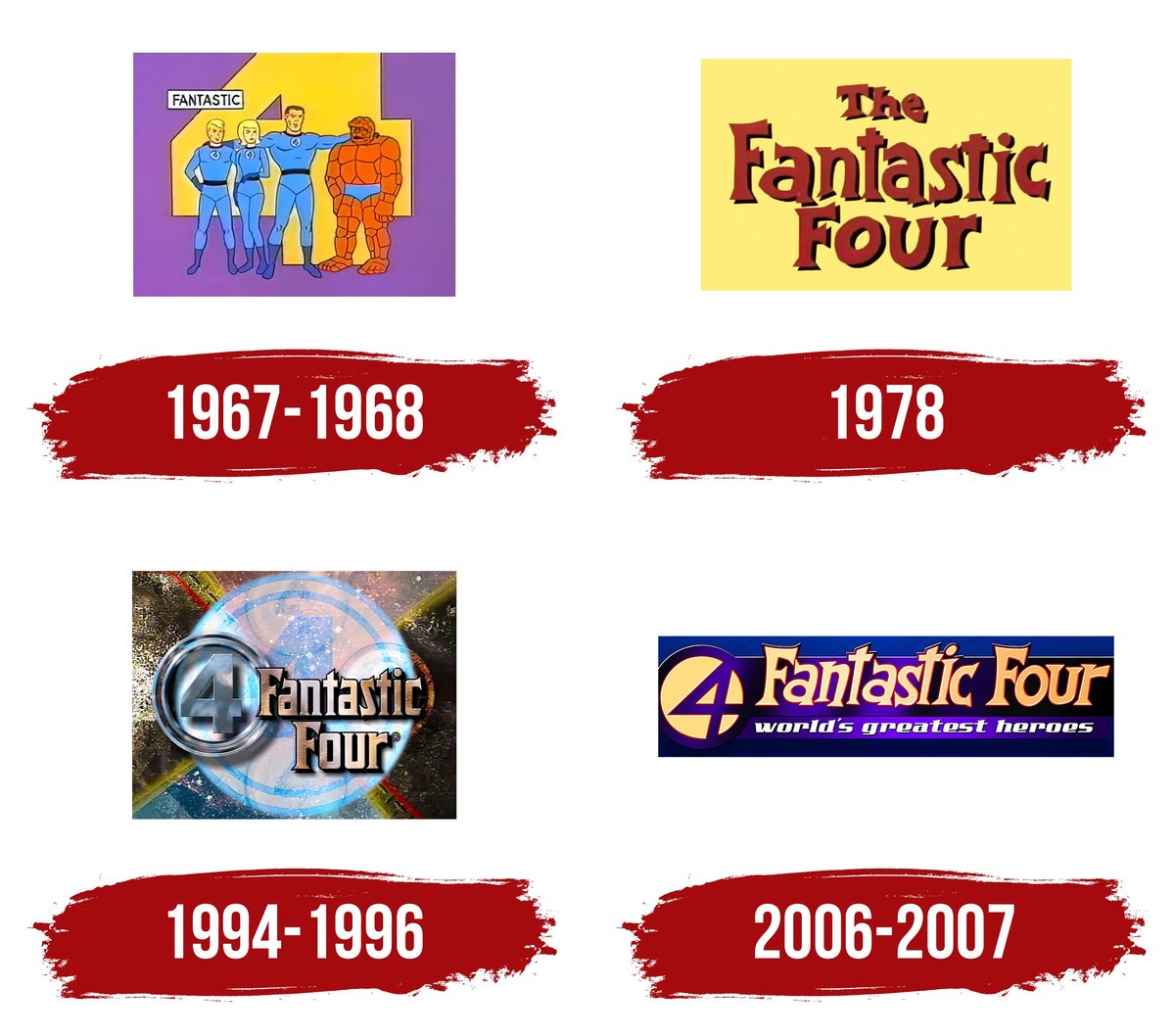
The first animated outing, Fantastic Four (September 1967 – September 1968), often featured title screens that were straightforward and effective. Typically, these included an image of the four characters dynamically posed in front of a large, distinctive yellow "4." This visually connected the team directly with their iconic symbol. The bold title screen itself featured "Fantastic" in a white rectangle, placed above a section of the team, with the large yellow "4" dominating the background. It was simple, direct, and unmistakably Fantastic Four.
A decade later, The New Fantastic Four (September 1978 – December 1978) presented a logo that leaned heavily on its comic book roots. This version was based on the original comic book design, employing an almost identical font in a bright, eye-catching red. This choice maintained a strong visual continuity with the source material, a common practice in early adaptations.
Modern Animation: Polished and Consistent (1994-2007)
The 1990s brought a more polished look to superhero animation. The Fantastic Four animated series (September 1994 – February 1996) showcased a logo that once again drew inspiration from a comic book wordmark. This iteration often featured metallic-looking glyphs, giving it a more advanced and sophisticated appearance. It also prominently displayed two Fantastic Four symbols: one positioned to the left of the wordmark and another, subtly transparent, behind it, adding depth and reinforcing the team's brand.
When Fantastic Four: World's Greatest Heroes premiered (September 2006 – October 2007), its logo returned to a font style remarkably similar to the original comic book typeface, but with a modern finish. This version consistently featured the Fantastic Four symbol positioned clearly to the left, ensuring immediate recognition while offering a fresh take on a classic. It was a well-balanced approach, respecting the legacy while updating the aesthetic for a new generation of viewers.
Cinematic Spectacle: The Logo on the Big Screen
Film logos carry a different weight. They must be iconic, instantly recognizable, and capable of holding their own on posters, trailers, and giant screens. They often represent significant financial investments and set the tone for an entire cinematic universe.
The 2000s Films: Sleek and Symbolic (2005-2007)
The first major live-action film adaptation, Fantastic Four (2005), directed by Tim Story, debuted a distinctly modern title screen. This logo featured the Fantastic Four symbol—the number "4" within a circle—not just as an accompanying icon, but as a separator between the two words. The design utilized a metallic-edged color palette, giving it a high-tech, polished feel suitable for a contemporary superhero blockbuster. This same aesthetic carried over to its sequel, Fantastic Four: Rise of the Silver Surfer (2007). The choice to integrate the "4" symbol so centrally spoke volumes about its branding power.
Intriguingly, the influence of this era's logo extends into the Marvel Cinematic Universe (MCU) as meta-references. The logo, evoking the spirit of these films, reappeared in the 2024 Marvel Cinematic Universe film Deadpool & Wolverine, a nod to Chris Evans' reprisal of his Human Torch role from the 2005 films. Similarly, the logo's appearance in 2022's Doctor Strange in the Multiverse of Madness, associated with John Krasinski's Reed Richards, served as a powerful visual callback to a beloved (or at least well-known) iteration of the team, showcasing how The Fantastic Four Logo can transcend timelines and universes.
The 2015 Reboot: Futuristic and Bold
The 2015 Fantastic Four remake, a significant departure in tone and origin, introduced a logo that mirrored later comic book versions by replacing the letter "A" with the "4 glyph." This iteration presented a slimmer, more modern sans-serif font, designed to convey power and a futuristic aesthetic. It aimed for a clean, almost minimalist look, reflecting the film's attempt at a grittier, more grounded, and technologically advanced take on the team. While the film's reception was mixed, its logo was a clear statement of intent: a modern, almost stark reinterpretation for a new era.
The Future of Film: MCU Integration (2025 and Beyond)
With a new Fantastic Four film confirmed for 2025 within the MCU, fans eagerly await what the next logo iteration will look like. Given the MCU's track record of blending comic book aesthetics with cinematic polish, it's highly probable we'll see a logo that is both respectful of the team's legacy and seamlessly integrated into the MCU's distinctive visual language. Expect something bold, perhaps with metallic textures, and an inevitable clever incorporation of the iconic "4" symbol.
The Gaming Realm: Adapting to Interactive Worlds
While specific Fantastic Four video game logo details are less exhaustively documented than their comic and film counterparts, it's safe to say that game developers consistently draw inspiration from the prevailing visual identities of the Fantastic Four at the time of their game's release. Whether it's a comic-accurate adaptation for a fighting game or a film-tie-in for an action-adventure title, game logos tend to mirror the most recognizable version of the team's branding. They serve as a bridge, ensuring that players instantly connect the game to the broader Fantastic Four universe, often reflecting the specific comic arc or cinematic release they are based on.
Dissecting the Visual DNA: Symbol, Colors, and Fonts
Beyond the specific wordmarks, certain elements form the bedrock of the Fantastic Four's visual identity, providing a thread of continuity through every variation.
The Iconic "4" Symbol
Without a doubt, the number "4" enclosed within a circle is the most recognizable and consistently deployed brand element of the Fantastic Four. It's more than just a number; it's a glyph that instantly signifies the team.
- Evolution of the Glyph: Earlier comic versions often depicted the "4" spread across the entire circle, sometimes even breaking its boundaries, giving it a dynamic, expansive feel. Recent versions, however, typically show the "4" connecting more subtly to the right side of the circle, or integrated within the wordmark itself. This evolution reflects a shift towards more refined, graphic design principles, making the symbol cleaner and more versatile for various applications. It's a powerful identifier, symbolizing unity, discovery, and the core quartet.
Color Palettes: Blue, White, and Beyond
Unlike some heroes with highly specific color schemes, the Fantastic Four's logos don't adhere to a single, rigid set of colors. However, blue and white are overwhelmingly the most common and associated colors, often reflecting their uniforms and the sci-fi, cosmic nature of their adventures.
- Versatility in Application: While blue and white are a frequent pairing, you'll find variations utilizing red for urgency, yellow for energy (especially with Human Torch), and metallic silvers or grays to evoke advanced technology or cinematic grandeur. This flexibility allows each iteration of the logo to be adapted for different media, moods, or promotional campaigns without losing its core identity. The lack of a strict color palette for the logo itself means the focus shifts more heavily to the unique typography and the "4" symbol.
Font Choices: Serif, Sans-Serif, and Statement
The choice of font is crucial in conveying a brand's personality, and the Fantastic Four's logos showcase a deliberate shift between different font styles.
- Comic Book Fonts: Recent comic book logos tend to favor serif fonts, often characterized by their capital letters and sharp, angular components. These fonts exude a sense of tradition, gravitas, and classic heroism, connecting back to the foundational art of comic book lettering. They feel robust and grounded, befitting the rich history of the characters.
- Movie Fonts: In stark contrast, recent movie logos almost exclusively opt for sans-serif fonts. These are typically sleek, narrow, and often engineered to look powerful and futuristic. Sans-serifs convey modernity, innovation, and a streamlined aesthetic, aligning perfectly with the high-budget, technologically advanced feel of contemporary blockbusters. The absence of serifs often makes these fonts feel cleaner and more impactful on a large screen or in fast-paced trailers.
Why So Many Changes? The Psychology of Logo Evolution
You might wonder why a brand as established as the Fantastic Four would undergo so many logo variations. It's not just arbitrary design choices; it's a calculated dance between maintaining recognition and staying relevant.
Adapting to Eras and Audiences
Every decade brings new design sensibilities. What looked cutting-edge in the 1960s might appear quaint today. Logos evolve to reflect the prevailing aesthetic trends, ensuring the brand doesn't feel dated. Each new iteration of the Fantastic Four also aims to capture the imagination of a new generation, often with a slightly different take on the team's core themes. A logo refresh can signal a new direction, a reboot, or simply an update to align with contemporary tastes.
Medium-Specific Needs
A logo designed for a comic book cover, intended to grab attention on a newsstand, has different requirements than one for a cinematic title sequence, which needs to convey epic scale, or a video game menu, which must be legible at various resolutions. Each medium imposes its own constraints and opportunities, leading to tailored designs.
Reinforcing Narrative Shifts
Sometimes, a logo change accompanies a significant narrative shift in the comics or a tonal change in an adaptation. A darker, grittier logo might accompany a more serious storyline, while a brighter, more classic design could signal a return to fundamental themes. The logo becomes a visual shorthand for the story it introduces.
The Power of Consistent Elements
Despite these numerous changes, the enduring success of the Fantastic Four's branding lies in its consistency. The bold, uppercase letters, the prominence of the word "FANTASTIC," and the ubiquitous "4" symbol act as anchors. They ensure that no matter how much the design evolves, the core identity of Marvel's First Family remains unmistakable. This blend of evolution and consistency is a masterclass in long-term brand management, ensuring that The Fantastic Four Logo always feels both fresh and familiar.
Beyond the Design: What These Logos Teach Us
Studying the Fantastic Four's logo journey offers valuable insights that extend beyond comic book fandom. It's a living case study in branding, design, and adaptation.
- Embrace Evolution, But Cherish Your Core: The FF logos demonstrate that change is inevitable and often necessary for a brand's longevity. Yet, the most successful variations always retain a strong connection to core identifiers – in this case, the bold name and the "4" symbol. What's the unchanging heart of your own brand?
- Context is King: A great logo for one medium isn't necessarily great for another. Understanding the environment in which your logo will appear – be it a billboard, a phone screen, or a video game console – is paramount to its effectiveness.
- Legibility Matters: While creative flourishes are appealing, the "4 glyph" replacing "A" in some iterations highlights a common pitfall: sacrificing clarity for cleverness. If your audience can't easily read or understand your logo, its impact is diminished.
- The Power of a Glyph: The "4" symbol proves that a simple, well-designed icon can become as powerful, if not more powerful, than the full wordmark. Think about iconic brand symbols in your own sphere; they often distill complex ideas into simple, memorable forms.
What's Next for Marvel's First Family's Emblem?
As the Fantastic Four prepares for its next major cinematic outing and continues its ongoing comic adventures, the evolution of its logo is far from over. We can anticipate future designs that will undoubtedly blend reverence for its storied past with cutting-edge graphic design, ready to introduce this incredible team to yet another generation of fans. Whether it's a sleek, cosmic emblem for the MCU or a vibrant, dynamic title for a new comic series, one thing is certain: the "4" will endure, a beacon for science, adventure, and family across the cosmos.
Understanding these Fantastic Four logo variations across film, TV, and games gives us a deeper appreciation for the thought and strategy that goes into maintaining a beloved brand. It’s a testament to the fact that even for a super-powered family, a strong visual identity is fundamental to their enduring legacy.